
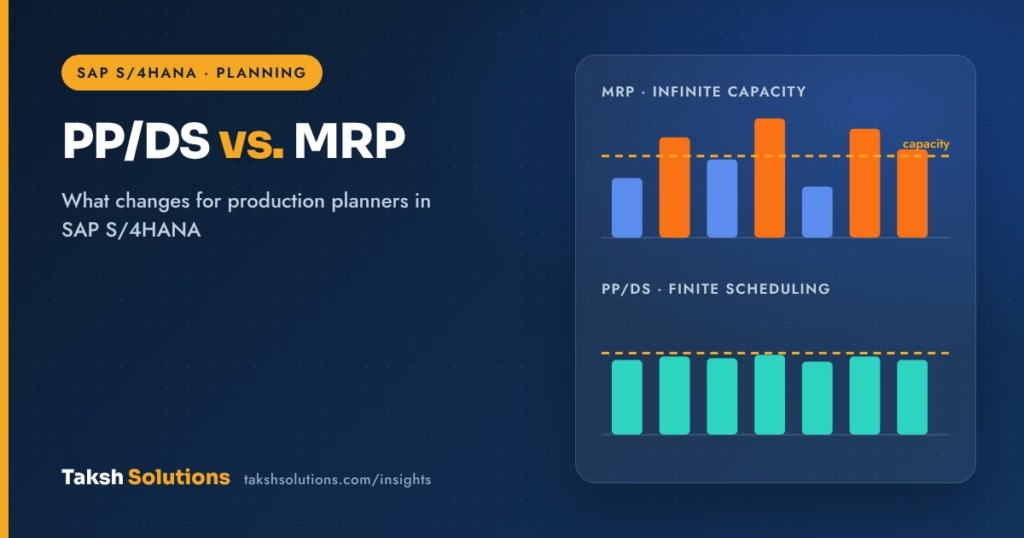
For years, SAP customers who needed more than material requirements planning (MRP) could give them had one answer: a separate SAP APO system, connected through the Core Interface (CIF). SAP S/4HANA changed that. Production Planning and Detailed Scheduling (PP/DS) can now run embedded inside the S/4HANA system itself, alongside MRP Live. That raises a practical question for every planning team on the road to S/4HANA: which materials and plants actually need PP/DS, and which are well served by MRP?
What MRP is built to do
MRP answers a simple, essential question: what do we need, how much, and by when? It nets demand against stock and open supply, explodes bills of material, and proposes planned orders and purchase requisitions. In S/4HANA, MRP Live runs directly on the HANA database and is significantly faster than classic MRP runs.
What MRP does not do is respect finite capacity. It assumes the work centres can absorb whatever it proposes, using lead times rather than a real schedule. Capacity problems are left for planners to find and fix afterwards, usually in spreadsheets.
What PP/DS adds
PP/DS is designed for the situations where “when” depends on what else is competing for the same resources. Its core capabilities include:
- Finite capacity scheduling. Orders are scheduled against the real availability of constrained resources, not just lead times.
- Heuristics. Configurable planning procedures for lot sizing, scheduling, sequencing and resolving capacity overloads, which can be run interactively or in background planning runs.
- Pegging. Dynamic links between receipts and requirements, so planners can see which customer or downstream order a delay will actually affect.
- Detailed scheduling. A graphical planning board for sequencing operations on bottleneck resources and reacting to disruptions.
- Alerts. Exception-based planning, so planners spend time on what has gone wrong rather than reviewing everything.
MRP Live vs. PP/DS at a glance
| Aspect | MRP Live | PP/DS (embedded) |
|---|---|---|
| Capacity | Infinite: schedules on lead times; capacity is checked separately | Finite: schedules against the real availability of constrained resources |
| Planning detail | Material requirements by date | Orders and operations scheduled in sequence on resources |
| Planning logic | MRP run with lot-sizing procedures | Configurable heuristics run interactively or in background planning runs |
| Visibility | Stock/requirements and MRP lists | Dynamic pegging, alerts and a detailed scheduling board |
| Extra master data | Material, BOM, routing, production version | The same, plus resources and production data structures (PDS) |
| Best suited to | Most materials: purchased parts, consumables, stable make-to-stock items | Capacity-critical, sequence-dependent or order-critical products |
Embedded PP/DS is not “APO inside S/4HANA”
Embedded PP/DS removes the separate system, but some of the architecture remains familiar. Master data is still transferred into PP/DS, and production data structures (PDS) replace the production process models used in APO. Materials are flagged for advanced planning, and only those materials are planned in PP/DS. Everything else stays in MRP.
That design is the key to a sensible approach: PP/DS is a scalpel, not a blanket. Planning every material in PP/DS adds data maintenance, run time and complexity without adding value.
A practical way to decide
When we work through this with a planning team, we look at a handful of questions for each product family and plant:
- Is capacity genuinely constrained? If a resource is regularly overloaded and the sequence of work matters, PP/DS earns its place.
- Do changeovers or sequence-dependent set-ups drive cost? Sequencing logic is where PP/DS heuristics are strongest.
- Do planners need to see order-level impact? If a late component must be traced to a specific customer order, pegging is valuable.
- Is the master data good enough? Finite scheduling exposes every inaccurate routing time and work-centre capacity. Poor data produces confident but wrong schedules.
- Who will own it? PP/DS needs planners who are trained to use heuristics, alerts and the planning board, and a support team who understands them.
Materials that are not capacity-critical, such as purchased parts, low-value consumables and stable make-to-stock items, are usually best left in MRP Live.
Common pitfalls
- Treating PP/DS as a technical switch. It changes how planners work every day. Process design and training matter as much as configuration.
- Underestimating master data. Routing times, work-centre capacities and production versions need to be cleansed before go-live, not after.
- Copying APO configuration unchanged. A move to S/4HANA is a chance to simplify heuristics and planning runs, not just to rebuild them.
- Skipping simulation. Run realistic planning scenarios with real volumes before cutover so that performance and results are understood.
Quick checklist before you choose
- List your bottleneck resources and how often they are overloaded today.
- Identify product families where changeover or sequence materially affects cost or output.
- Confirm whether planners need to trace delays to specific customer or downstream orders.
- Measure routing-time and capacity data accuracy for the candidate products.
- Name the planners and support team who will own PP/DS day to day.
- Run a simulation with production-like volumes before committing to scope.
Key terms in plain English
- MRP Live – the S/4HANA material requirements planning run, executed directly on the HANA database.
- Embedded PP/DS – advanced production planning and detailed scheduling running inside the S/4HANA system, rather than in a separate APO system.
- Finite scheduling – scheduling that respects how much capacity a resource actually has.
- Heuristic – a configurable planning procedure, for example for lot sizing, scheduling or resolving overloads.
- Pegging – the link between a supply element (receipt) and the demand it covers.
- PDS (production data structure) – the planning master data PP/DS uses, generated from the production version, BOM and routing.
Free PP/DS suitability assessment template
To help you decide material by material, we have turned the questions in this article into a free Excel workbook. Score each product family or plant, and the template calculates a weighted score and a recommendation, flagging where data quality needs fixing first.
| Template / tab | Use it to | Key fields |
|---|---|---|
| Criteria & weights | Agree what matters most in your plants and set the decision thresholds | Five criteria, weights (must total 100%), PP/DS and MRP Live thresholds, data-quality floor |
| Suitability matrix | Score product families / plants and get a recommendation | Scores 1–5 per criterion, weighted score, recommendation: PP/DS, Review, MRP Live or Fix data first |
| Readiness checklist | Confirm prerequisites before switching materials to PP/DS | Area, prerequisite, owner, status; overall readiness % |
Preview: suitability matrix
| Product family | Capacity | Sequence | Pegging | Data | Ownership | Score | Result |
|---|---|---|---|---|---|---|---|
| Example: machined housings | 5 | 4 | 4 | 3 | 3 | 3.95 | PP/DS |
| Purchased fasteners | 1 | 1 | 1 | 4 | 3 | 1.90 | MRP Live |
| Sub-assemblies, line 2 | 3 | 3 | 2 | 2 | 3 | 2.65 | Fix data first |
The criteria, weights and thresholds are a generic starting point. Adjust them to your plants and planning strategy.
The bottom line
MRP and PP/DS are complementary. MRP Live keeps the bulk of materials moving quickly and simply. PP/DS adds precision where capacity, sequence and order-level visibility determine whether the plan can actually be executed. The best results come from deciding deliberately, material by material, rather than defaulting to one or the other.
Planning an S/4HANA move or reviewing your production planning set-up? Talk to Taksh Solutions about a fit-gap review shaped around how your plants actually run.