
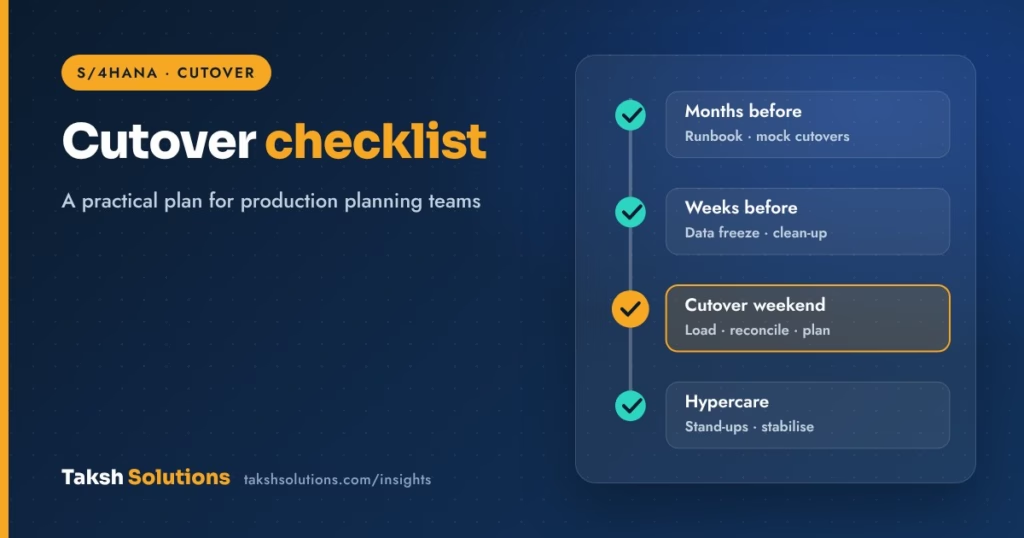
Cutover is the shortest phase of an SAP S/4HANA programme and often the most stressful. For production planning, it is the moment when master data, open orders, stock and planners all have to move to the new system at once, while the factory keeps running. A clear, rehearsed checklist turns that weekend from a gamble into a controlled sequence.
Months before: plan and rehearse
- Agree the cutover strategy. Decide which open orders will be migrated, which will be completed or closed in the legacy system, and which will simply be regenerated by planning in S/4HANA.
- Build a detailed runbook. Every task with an owner, a duration, dependencies, and a verification step. Include the business tasks, not just the technical loads.
- Run mock cutovers. At least two full rehearsals with production-like data volumes. Time every step, record every issue, and update the runbook after each one.
- Define go/no-go criteria. Agree in advance what “ready” means, such as data quality thresholds, test results and open defects, so the decision is made on evidence.
Weeks before: freeze and prepare
- Set a master data freeze. Limit changes to materials, BOMs, routings and work centres, with an agreed emergency-change process for anything that cannot wait.
- Clean up open transactions. Close or complete old production orders, remove obsolete planned orders and resolve stuck documents so there is less to migrate.
- Plan production around the outage. Build ahead where possible, print or export work lists, and agree how the shop floor will operate while systems are unavailable.
- Prepare planners. Train on the new transactions and apps, and walk through the first-week routine they will follow after go-live.
Cutover weekend: load and verify
- Stop legacy transactions at the agreed time and take final extracts.
- Load master data in dependency order: materials, BOMs, work centres, routings, production versions, then sources of supply.
- Activate planning integration. Where embedded PP/DS is used, transfer the relevant master data and generate production data structures, then check that the expected products and resources are present.
- Load stock and open orders, and reconcile quantities and values against legacy totals with finance and operations sign-off.
- Run planning. Execute MRP Live, and PP/DS heuristics where used, then review results with planners for key products and bottleneck resources.
- Smoke-test execution. Convert a planned order, release a production order, issue components, confirm an operation and post a goods receipt.
- Make the go/no-go call against the criteria agreed in advance.
After go-live: hypercare
- Daily planning stand-ups to review exceptions, capacity issues and order delays together.
- A visible issue log with clear priorities, owners and response times.
- Monitor key indicators such as planning run times, exception volumes, schedule adherence and order release backlog.
- Floor support from people who know both the process and the system, close to the planners in the first weeks.
- A planned exit from hypercare based on stability measures, with lessons captured for the next plant or wave.
Free cutover templates
To make the checklist easier to put into practice, we have turned it into a free Excel workbook with five ready-to-adapt templates. Each tab uses drop-down lists and built-in formulas, so planned end times, reconciliation variances and the overall go/no-go result calculate automatically.
| Template | Use it to | Key fields |
|---|---|---|
| Cutover runbook | Sequence every task from freeze to go-live and compare each mock cutover against plan | Phase, owner, predecessor, planned start and duration, actual times, status, verification step |
| Open order strategy | Decide per object whether open documents are migrated, closed or regenerated | Selection criteria, strategy, rationale, legacy and S/4HANA counts, variance |
| Load & reconciliation | Load objects in dependency order and prove counts and values match | Dependencies, legacy vs. S/4HANA counts and values, tolerance, within-tolerance flag, sign-off |
| Go / no-go criteria | Agree the go-live decision rules in advance and record the evidence | Category, criterion, threshold, mandatory flag, met, owner; automatic GO / NO-GO |
| Hypercare issue log | Track post-go-live issues until the operation is stable | Area, priority, owner, status, target and resolved dates, days open |
Preview: cutover runbook (first tasks)
| ID | Phase | Task | Predecessor | Hrs | Verification |
|---|---|---|---|---|---|
| T01 | Pre-cutover | Confirm go/no-go for cutover start | — | 1.0 | Go decision recorded |
| T02 | Pre-cutover | Freeze master data changes in legacy | T01 | 0.5 | Freeze notice issued; change log closed |
| T03 | Pre-cutover | Close or complete agreed legacy production orders | T02 | 4.0 | Open order count matches strategy |
| T04 | Legacy shutdown | Stop legacy planning and execution transactions | T03 | 0.5 | Access locked; batch jobs suspended |
| T05 | Legacy shutdown | Take final legacy extracts | T04 | 3.0 | Record counts logged for reconciliation |
Preview: go / no-go criteria
| Category | Criterion | Evidence required |
|---|---|---|
| Data | Master data loaded and reconciled within tolerance | All objects pass on the reconciliation tab |
| Data | Stock balances reconciled with finance | Quantity and value sign-off |
| Testing | End-to-end smoke test passed | Plan → produce → receive completed |
| Planning | Planning results reviewed with planners | Key products and bottleneck resources accepted |
| Support | Hypercare team and issue process in place | Rota, contacts and log ready |
The templates are a generic starting point. Adapt the tasks, objects and tolerances to your landscape, data volumes and governance.
The bottom line
A successful production planning cutover is rarely about heroics on the weekend itself. It is the result of a rehearsed runbook, clean data loaded in the right order, clear decision criteria and planners who are ready on day one.
Planning an S/4HANA move or reviewing your production planning set-up? Talk to Taksh Solutions about a fit-gap review shaped around how your plants actually run.